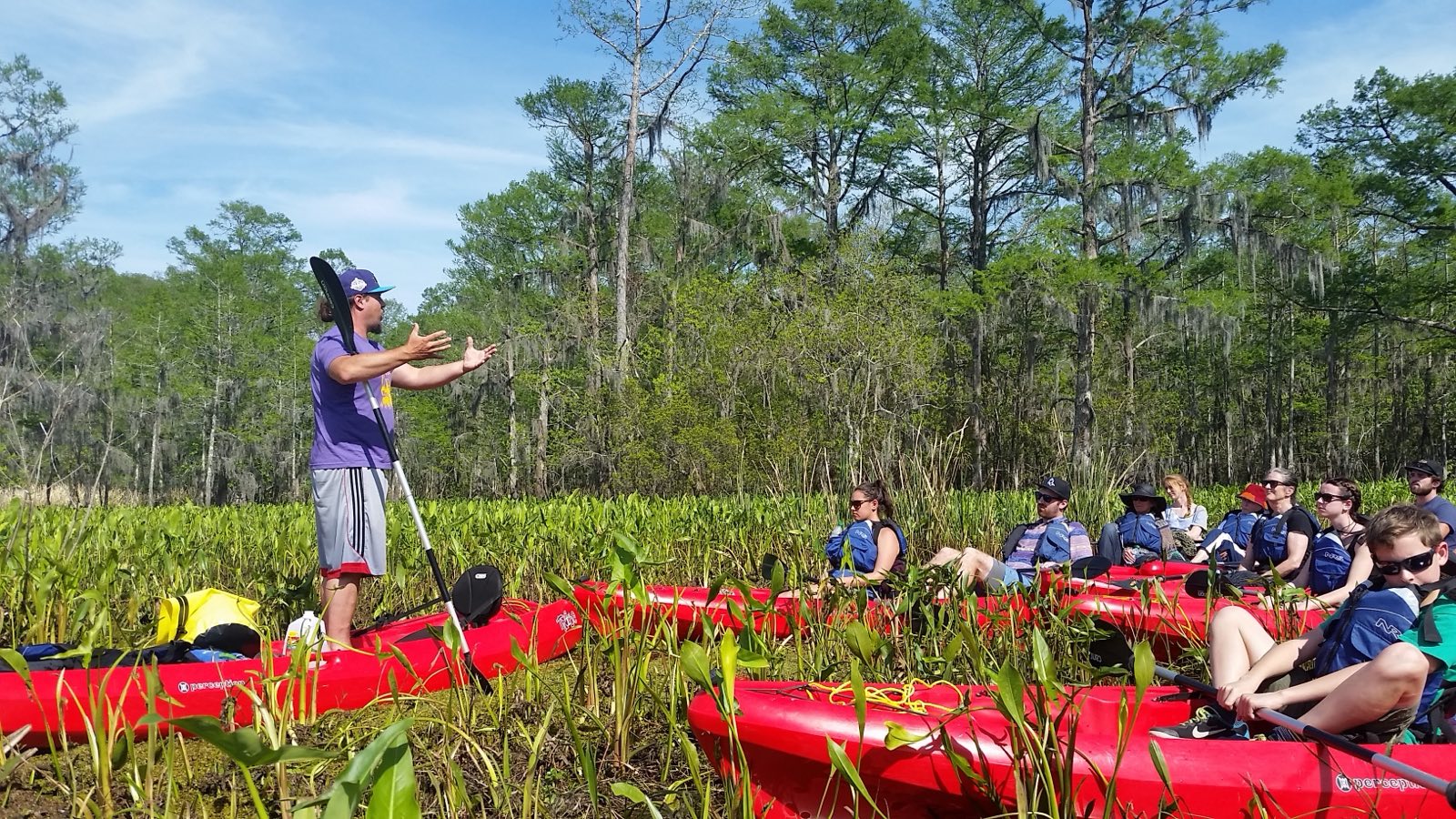

Bayou St. John is the only reason New Orleans makes geographic sense. The French built a major city on an island of mud between a river and a lake because of this bayou: a four-mile tidal channel that gave them a back door from Lake Pontchartrain to the high ground of the natural levee. The city that became one of the most consequential in American history was founded at the bayou’s edge. You can kayak the whole thing on a quiet morning.
The original route
Long before European settlement, the Choctaw and other Native people used Bayou St. John as a portage route. A short carry between the bayou’s north end and Lake Pontchartrain connected the lake to the Mississippi River without having to navigate the river’s delta, which is long, shallow, and difficult to move upstream. It was a shortcut through Louisiana’s geography and the knowledge of it was critical.
When Jean-Baptiste Le Moyne de Bienville was looking for a site for a French colonial city in 1718, he chose the portage spot. The strip of high ground between the river and the bayou, barely above sea level, was the best defensible and accessible position available. The city that became New Orleans grew from that logic.
Smugglers, pirates, and produce
For most of the 18th and early 19th century, Bayou St. John was a working commercial waterway. Boats came in from Lake Pontchartrain carrying trade goods, produce from the north shore, and, less officially, contraband. The bayou’s terminus at the old Spanish Custom House (still standing, now a landmark on Moss Street) was where goods officially entered the city. What came in after dark was another matter.
Jean Lafitte, whose Barataria smuggling network fed New Orleans markets from the south, had counterparts running goods through the bayou from the north. The city’s appetite for cheap goods was more than official channels could fill.
What it became
By the 20th century Bayou St. John had been shortened by canal construction and was no longer a working trade route. The city grew around it. Today it runs through Mid-City, bordered by park and residential neighborhoods, with a different relationship to the city than any other stretch of water in Louisiana. It is genuinely urban, surrounded by porches and coffee shops, but still a natural waterway, still tidal, still with herons working the shallows.
Paddling it is unlike paddling Manchac or Honey Island. There is no Spanish moss tunnel, no alligator on every log. What there is: the city, visible and present, the layered history of a waterway that created the place, and the particular pleasure of being on moving water in the middle of New Orleans. Many people do Bayou St. John first, to get comfortable in a boat, and then head to the swamp.
Our full Bayou St. John paddling guide covers the logistics. For the full swamp experience after that, the Manchac guide is the obvious next stop.
Common questions
Why is Bayou St. John historically important?
Bayou St. John was the portage route that connected Lake Pontchartrain to the Mississippi River for Native Americans long before European settlement. Jean-Baptiste de Bienville chose the bayou’s edge as the site for New Orleans in 1718 because of this geographic advantage.
Can you kayak Bayou St. John?
Yes. Bayou St. John runs about four miles through Mid-City New Orleans and is a popular urban paddle. It is calm, has no significant current, and is accessible by public launch points along Moss Street near City Park.
Are there alligators in Bayou St. John?
Alligator sightings are rare in Bayou St. John compared to the Manchac and Honey Island swamps. It is the best paddle in New Orleans for people nervous about gators, along with being a good first-paddle option before a swamp tour.
How long is Bayou St. John?
The navigable section of Bayou St. John runs about four miles from the spillway near Lake Pontchartrain south toward Mid-City. A round-trip paddle takes between one and two hours at a relaxed pace.
Start on the bayou, then go deeper.